
- HOMEGROWN WORLD
- HGCREATORS
- HGEXPLORE
- HGVOICES
- HGSHOP
- CAREERS
- ABOUT US
- CONTACT US
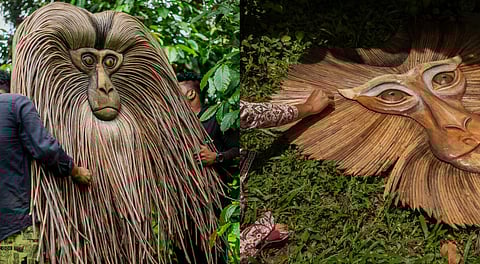
Gudalur-based social enterprise The Elephant People creates 4–8 ft primate sculptures from invasive plants like Lantana camara and Senna spectabilis as a form of reflection on what it means to co-exist alongside the natural world in the Nilgiris. Centred around building stable livelihoods for local adivasi artisans and communities, the project transforms these invasives plant species into public artworks that mirror human-like primate expressions while also contributing to forest restoration, conservation, and livelihoods.
The Elephant People’s Primate Sculptures pull you in with a stare. From 4 to 8 feet tall, their primate sculptures look back at you with carved senna-wood eyes, framed by cascades of lantana “fur” built on the fringes of the forests of the Nilgiri Biosphere Reserve.
Based in Gudalur in the Nilgiris, The Elephant People is a social enterprise born from The Real Elephant Collective, the team behind the Great Elephant Migration’s life-sized lantana elephants that many in Bengaluru and beyond have already met. For over a decade, this collective has been crafting sculptures modelled on real wild elephants they live alongside, using the invasive shrub Lantana camara as both material and metaphor.
With the primate series, that coexistence story shifts from megafauna to the often-overlooked monkeys and apes sharing the same fragmented habitats. The 'Primates of India' collection already includes hand-carved masks of Phayre’s leaf monkey, capped langur, Nilgiri langur, northern pig-tailed macaque, and male and female hoolock gibbons. The 4–8 ft sculptures scale those faces up into forms more suitable for public, spatial encounters, much like the ones at the recent Sixth Sense Festival in Bengaluru.
The sculptures combine stems of Lantana camara with timber from Senna spectabilis, another aggressively spreading invasive tree that chokes out native grasses. Invasive trees and shrubs affect wildlife, mainly by changing their habitat and food supply. As per research, this has been a factor in increased human wildlife conflict.

Rhea Antony Bennan, who handles Storytelling & Branding at The Elephant People, explains things further:
“We work with woody invasives to create handmade products inspired by the forests. The primate sculptures have 'hair’ woven from lantana, faces carved from senna.” Behind the aesthetic is a quiet, unassuming, but thorough engine. While centred around building stable livelihoods for local adivasi artisans and communities, The Elephant People work closely with a research team to study how our forests are changing and what it would take to build a strong balance for both flora and fauna.
"We are currently developing a structured framework to allocate a portion of our profits toward research that informs forest restoration, alongside community projects that reconnect people with nature", she adds. In that sense, each primate sculpture is an intervention twice over: a material diversion of harmful invasives into long-lived art, and a way to give back to the communities living in the Nilgiris.
