
- HOMEGROWN WORLD
- HGCREATORS
- HGEXPLORE
- HGVOICES
- HGSHOP
- CAREERS
- ABOUT US
- CONTACT US
Revisiting Bourdain’s relationship with India in light of ,'Tony', his upcoming biopic, the piece explores how he approached Kerala, Mumbai and Punjab as layered, contradictory spaces shaped by history, migration and resilience. Ultimately, it argues that Bourdain’s greatest gift was his ability to pay attention and allow places to reveal themselves on their own terms.
I first came across Anthony Bourdain when I was 14, rummaging through my dad’s somewhat sparse book collection, and stumbled upon Kitchen Confidential. It was a thin, slightly battered book, but the blurb on the back promised an unflinching deep dive into “sex, drugs, bad behaviour, and haute cuisine” — and for a 14-year-old, that was a pretty easy sell.
I devoured it in one sitting on a Sunday afternoon. I can still remember the physical sensation of my world expanding as I turned the pages. It wasn’t that I suddenly wanted to become a chef or enter the hospitality industry. Rather, Bourdain’s story awakened something more instinctive and difficult to name: a sense of rapture, curiosity and possibility that felt both innate and profoundly real. I wanted more of whatever it was that the book had stirred in me.
So I watched episode after episode of his documentary series, 'Anthony Bourdain: Parts Unknown' and 'Anthony Bourdain: No Reservations'. Despite being framed around food, these shows never really felt like food shows. They were stories about people and their lives shaped by their socio-cultural and socio-economic worlds. Food was simply the vehicle, a way into lives and histories that might otherwise remain inaccessible. A bowl of noodles or a plate of rice was never just dinner; it was an archive, an argument, a map of power and survival. Bourdain visited parts of the world that had so often been exoticised, but refrained from reducing them to an aesthetic or a brand.
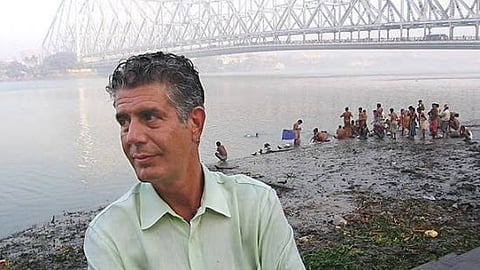
The trailer for his biopic, 'Tony', directed by Matt Johnson, was released recently, and it feels like the right time to revisit Bourdain’s relationship with India. Unlike many Western travel personalities who approached India either as a spiritual cliché, Bourdain seemed genuinely interested in its contradictions. He understood that a geographical region as expansive and layered as ours could not be flattened into a single narrative.

He was overwhelmed by it and occasionally uncomfortable — even visibly frustrated at times — but he never dismissed the cultural experience India had to offer. Instead, he tried to engage with the country as it is: excessive, contradictory and impossible to fully understand. In his own words, “India would be a life’s work — and an unfinished one — no matter how long we spent there.”
In Kerala, featured in No Reservations, Bourdain seemed mesmerised by the sheer abundance of the landscape and its relationship to food. He travelled through the backwaters, ate seafood pulled almost directly from the water, and immersed himself in the Syrian Christian culinary traditions of the state. Kerala, in Bourdain’s telling, was a place shaped by centuries of trade and migration: Arab, Portuguese, Dutch and British influences coexisting with deeply rooted local traditions. He was struck by how global Kerala felt while remaining fiercely itself. From visiting Kerala and national legend Mammooty on set for lunch to eating a complete sadhya meal at a local chef’s home, Bourdain travelled the entire expanse of the state.
In Mumbai, however, Bourdain encountered something entirely different: velocity. Mumbai in his telling was restless, exhausting, unequal and utterly magnetic. He moved through crowded streets and kitchens that seemed to pulse with impossible energy, eating everything from street-side snacks to refined restaurant meals. He captured Mumbai in its relentless ambition. Food, here, became a way of understanding migration itself, through communities arriving, and remaking the city through kitchens. In a lot of ways, Bourdain started the trend of the backpacker traveller who set foot into a place with no plan, only a zest to absorb culture and learn more.
In the Parts Unknown episode on Punjab, he encountered a region marked by warmth, grief, resilience, and overwhelming generosity. Much of the episode centred on the aftermath and memory of the violence of the 1980s and the lingering trauma surrounding the anti-Sikh riots, but also on the everyday joy that persisted despite it. He spent time with farmers and families, explored Sikh identity, and visited the community kitchens of gurdwaras, where food is an act of equality and service.
Punjab, for Bourdain, was deeply tied to hospitality, he recognised how food here carried survival. Shared meals were political and communal, rooted in histories of displacement and faith. Watching him sit cross-legged at a langar, eating alongside strangers, felt emblematic of what made his work compelling: he was not interested in the grandiose, but in understanding what food reveals about how societies organise care.
What I admired most was that Bourdain never claimed expertise. He didn't arrive in a country pretending he could decode it completely within an hour-long episode. India, especially, seemed to humble him. There was a visible awareness that he knew he was only scratching the surface, and that humility made his engagement feel more honest. He was willing to be confused and, more importantly: to be wrong.
Through Bourdain, I began to understand that good storytelling is about sitting with a place’s contradictions long enough to let it reveal itself. Because if there was one thing he was better at than most people — even the natives of a space — it was paying attention.
Watch the 'Tony' trailer here.
If you enjoyed reading this, here's more from Homegrown:
In Memory Of Anthony Bourdain And The Lessons He Taught Us
The Ōle Project Is Documenting Karnataka's Forgotten Flavours
A Doctor's Life Beyond The Hospital: Inside Yohan Irani’s Scrumptious Dublin Supper Club
