
- HOMEGROWN WORLD
- HGCREATORS
- HGEXPLORE
- HGVOICES
- HGSHOP
- CAREERS
- ABOUT US
- CONTACT US
India is set to host Panama, Brazil and Uruguay in one of the most significant periods in its footballing history, drawing unprecedented attention to the sport. While packed stadiums and international fixtures signal growing public enthusiasm, they also expose a longstanding contradiction at the heart of Indian football. As local grounds disappear, grassroots tournaments struggle for support, and youth development remains under-resourced, the excitement surrounding marquee friendlies raises an urgent question: can India become a true footballing nation if the foundations of the game continue to be neglected?
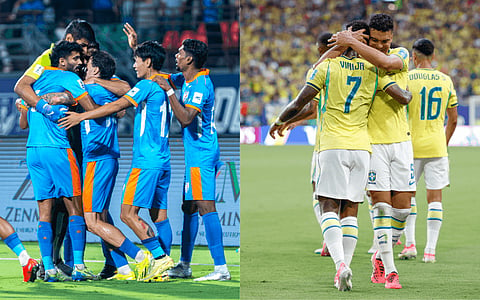
Indian football is about to have its loudest month in years. On September 26, the Blue Tigers face Panama, a team ranked 44th in the world and fresh off a World Cup appearance, at Bengaluru's Sree Kanteerava Stadium, in what will be the first-ever meeting between the two nations. A week later, on October 3, five-time world champions Brazil arrive in Kolkata to play at the Vivekananda Yuba Bharati Krirangan, marking the highest-ranked opposition India will have faced since FIFA rankings began in 1992. Three days after that, Uruguay follows, at the same Kolkata venue.
For a footballing nation that's spent decades on the margins of the sport's global conversation, this is a big deal. Sree Kanteerava will be packed with the same fervour that carried India to the SAFF Championship there in 2023. Kolkata, a city that has bled football for a hundred years, gets to watch Neymar's teammates warm up on its own turf. Television and streaming deals are in place, sponsors have been bagged, and for a fortnight, football will dominate a sporting conversation that Indian cricket has owned unchallenged for as long as most fans can remember.
But this moment feels like a double-edged sword.
On one edge: visibility, and it's richly deserved. Every time a stadium fills up for a football match in India it proves something that the sport's administrators have long struggled to convince anyone of that Indians are invested in football. Not as an imported curiosity, but as something they'll show up for, argue about, and paint their faces for. The response to marquee fixtures, big-ticket tournaments, and FIFA events hosted on Indian soil has made that abundantly, repeatedly clear.
The other edge is a little uncomfortable and tricky. Because while the national team prepares to host the sport's royalty, the actual foundations of Indian football, the maidans, the local grounds, the school and district-level tournaments that are supposed to produce the next generation of players, are treated with almost an institutional indifference. Grassroots football in our country lacks grounds to play on, coaches to develop that talent, tournaments to sustain it, and any real conviction from the people who run the sport that this is where the actual work happens.
The same cities hosting Brazil and Uruguay this October have, in the very recent past, seen local football grounds, the exact kind of open spaces where neighbourhood tournaments are held, where kids first touch a ball competitively, earmarked for "redevelopment." Concretisation, commercial complexes, parking lots, stadium retrofits that quietly eat into the playing area available to junior football. These are the breeding grounds of the sport, in the most literal sense, the spaces where a Sunil Chhetri or a Bhaichung Bhutia first learned to trap a ball. When that space shrinks, so does the pipeline that Indian football claims to be desperate for.
The country wants a stronger national team, wants to compete with the CONCACAFs and CONMEBOLs of the world rather than just host them for a friendly, wants the kind of footballing culture that Brazil or Uruguay have built over a century, but keeps failing to protect the very grounds where that culture would need to grow. You cannot build a footballing nation on marquee friendlies alone.
None of this is an argument against hosting Panama, Brazil, or Uruguay — quite the opposite. These matches matter, and Indian football has earned them through the sheer weight of public interest.
But the responsibility doesn't rest on administrators and city planners alone, it rests on us, the audience, too. It's easy to fill a stadium for Brazil and call it proof of love for the game; it's far more meaningful, to show up for an I-League fixture, a state-level derby, or an U-17 tournament where the stands are half-empty and no camera crew is waiting outside. If we want Indian football to be taken seriously, we have to take it seriously first, by following domestic leagues the way we follow the Premier League, know the names of local clubs and academy players the way we know foreign strikers, and treat our up and coming homegrown players with the same curiosity we reserve for a marquee friendly.
If you enjoyed reading this, here's more from Homegrown:
Here Are Some Of Our Favourite Homegrown Football Movies
Every World Cup Spotlights The Tragedy & Hopeless Romance Of Indian Football
A New Era In Indian Women's Football: Team India Aim For World Cup Glory

