
- HOMEGROWN WORLD
- HGCREATORS
- HGEXPLORE
- HGVOICES
- HGSHOP
- CAREERS
- ABOUT US
- CONTACT US

The proposed conversion of Mumbai’s Neville D’Souza Football Ground into a convention centre has triggered widespread opposition from players, coaches, and residents. Beyond football, the controversy highlights the city’s worsening open-space crisis and the growing tension between public recreation and commercial development.
For every citizen living in the city, Mumbai averages only 1.5 square metres of open green space, well below the World Health Organisation (WHO) recommended benchmark of 9 square metres per capita. While the city offers iconic coastal stretches, it struggles to compete with the vast, master-planned recreational areas found in other global cities. Open green spaces are a rare commons in Mumbai — and the recent uproar over the Neville D’Souza Football Ground is a clear example of how dire the situation has become for India’s industrial capital.
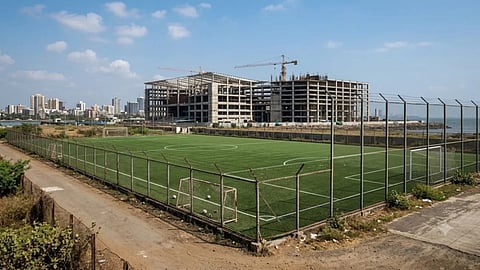
Spread across roughly 8,450 square metres in Bandra West, the Neville D’Souza Football Ground was developed in 2018 by the Mumbai Metropolitan Region Development Authority (MMRDA) with FIFA-standard artificial turf. Named after Neville D’Souza — the first Asian footballer to score a hat-trick at the Olympic Games during the 1956 Melbourne Olympics — the venue can accommodate up to 5,000 spectators.
In the years since its opening, the ground has emerged as the centre of Mumbai’s football ecosystem. As several football venues across the city, including the historic St Xavier’s Ground in Parel, have disappeared or become inaccessible, the Neville D’Souza Football Ground has become Mumbai’s only major dedicated football facility. The venue hosts a packed calendar of grassroots coaching programmes, league fixtures, and competitive tournaments throughout the year. Nearly 400 youth teams and around 300 senior clubs use the facility, with an estimated 8,000 to 10,000 boys and girls training and competing there on a regular basis.
On 24 June 2026, the Brihanmumbai Municipal Corporation’s (BMC) Improvements Committee approved a proposal to change the reservation of the plot from a sports ground and playground to an exhibition and convention centre. The proposal was initiated by the Maharashtra Housing and Area Development Authority (MHADA), which has argued that the land was originally earmarked for a convention complex under the Bandra Reclamation development plan prepared in the 1980s.
Although the proposal must pass several stages, including approval by the BMC General Body, a public objections process, and final clearance from the Maharashtra government, it has already sparked strong reactions from Mumbai’s football community. Players and coaches say losing the ground would severely impact grassroots football, with hundreds of youth teams and amateur clubs relying on it for training and matches. Aspiring footballers struggle to find affordable playing spaces. Recent protests involved footballers, parents, administrators, and residents voicing opposition. Critics argue that replacing the sports facility with a convention centre reflects a pattern in which commercial development is prioritised over public recreation and community infrastructure.
The debate has also highlighted a larger urban planning challenge facing Mumbai. As land values continue to rise and development pressures intensify, open spaces are becoming increasingly scarce. While supporters of the proposal point to the economic and civic benefits a convention centre could bring, opponents contend that cities need public sporting spaces as much as they need commercial infrastructure. For now, the future of the Neville D’Souza Football Ground remains uncertain. But the controversy has already transformed the venue into a focal point for a wider conversation about sport, public space, and the kind of city Mumbai wants to become.
