
- HOMEGROWN WORLD
- HGCREATORS
- HGEXPLORE
- HGVOICES
- HGSHOP
- CAREERS
- ABOUT US
- CONTACT US
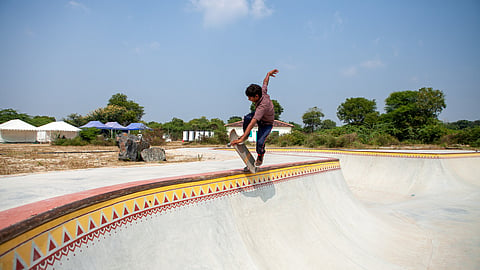
Originally built for the Netflix film 'Skater Girl', Desert Dolphin Skatepark evolved into a permanent community space that offers free skateboarding programs for local children. Beyond teaching tricks and techniques, Desert Dolphin uses skateboarding as a tool for confidence-building, education, and social development. Through workshops, mentorship, and an inclusive approach, the organisation empowers young people from surrounding villages while fostering a growing skateboarding culture in India.
In the village of Khempur, Rajasthan, an unlikely symbol of possibility rises from the desert landscape: a 14,500-square-foot skatepark that has transformed the lives of hundreds of children. Known as Desert Dolphin Skatepark, the facility began as part of the production of the Netflix film 'Skater Girl', but its story did not end when filming wrapped. Instead, it evolved into one of India's most inspiring examples of how sport can become a catalyst for social change.
Constructed between 2018 and 2019 for the film, the skatepark occupies a one-acre campus and is recognised as Rajasthan's first skatepark. It is also among the largest in India. Built with the expertise of skatepark builders from 100 Ramps alongside Indian and international volunteers, the space was designed not merely as a film set but as a lasting community resource. Following the completion of filming, the park remained open to the public free of charge, ensuring that local children could continue to access the opportunities it created.
For many young people in and around Khempur, the skatepark functions as a second home. Daily workshops introduce children from nearby villages and schools to skateboarding, a sport that encourages creativity, resilience, and self-expression. In a region where recreational infrastructure can be limited, the park provides a safe environment where children are encouraged to dream bigger and develop confidence in their abilities.
The organisation's mission extends beyond producing skilled skateboarders. The team behind Desert Dolphin views skateboarding as a tool for personal development, helping young people build character, independence, and a sense of community. While the park supports talented skaters who aspire to compete at state and national levels, it also emphasizes broader life skills and positive social engagement. Its vision is rooted in creating an inclusive environment where education, mentorship, and personal growth are as important as athletic achievement.
The skatepark was born from the vision of filmmaker and Skater Girl director, Manjari Makijany, alongside co-founders Vinati Makijany and Emmanuel Pappas. Their work is supported by a diverse team of educators, community leaders, health professionals, and skateboarding pioneers who continue to expand the park's programs and outreach.
Today, Desert Dolphin Skatepark stands as more than a sporting facility. It is proof that a single space, when built with purpose and sustained by community, can reshape futures.
Follow Desert Dolphin Skatepark via Instagram.
If you enjoyed reading this, here’s more from Homegrown:
Deepak Thomas Created A Board Game Based On Mumbai's Chaotic Everyday Commute
Girls Skate Hyderabad Is Changing Who Skateboarding Is For
'Bedlam In Bandra' Is An Up-Close & Intimate Portrait Of Mumbai Skate Culture
