
- HOMEGROWN WORLD
- HGCREATORS
- HGEXPLORE
- HGVOICES
- HGSHOP
- CAREERS
- ABOUT US
- CONTACT US
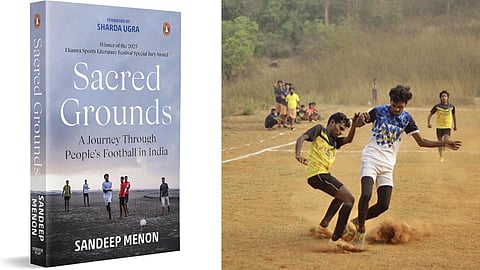
Sandeep Menon’s book 'Sacred Grounds: A Journey Through People’s Football in India' investigates how football grounds across the country reflect social, political, and cultural dynamics at the grassroots level. It moves through regions like Nagaland, Punjab, Mizoram, and Kerala to document community tournaments, informal pitches, and local fan cultures. Sandeep shifts focus here from the big professional clubs to everyday players, supporters, and neighbourhoods. Football is presented as a medium through which questions of identity, community, class, and history become visible, rather than as a stage for star-driven narratives. It's a deep study into “people’s football”, making it accessible even to readers without a strong prior interest in the game.
Kohima, Nagaland, 2008. Dr Wati Aier did something unusual to end a war. He facilitated a football match. Naga underground factions had been fighting each other for years. Naga civil society and church bodies has been working towards reconciliation. While it didn’t end the conflict entirely, the match worked as a beginning. Sandeep Menon’s 'Sacred Grounds: A Journey Through People's Football in India', is filled with such stories where the football field stands for something larger.
I'll admit upfront that I am not much of a football person. I follow it loosely, and have never had strong feelings about who wins what league. But when Sandeep Menon speaks about his new book, I found myself genuinely absorbed, because what he is really talking about, under the guise of football, is India itself.
Sandeep Menon is a sports journalist who has reported for publications like Deccan Chronicle, Times of India, and Deccan Herald. His first book, 'Out of the Blue', chronicled the rise of Bengaluru FC. Sacred Grounds is a different kind of project; a journey through India's football heartlands, from the hills of the Northeast to the coasts of Kerala, mapping the country through its football culture.
How The Game Arrived
While there have been precursors of football in various cultures across the subcontinent, football in its modern form arrived in India through the British, carried by the army and missionaries into specific pockets of the country. Cantonment towns produced footballers because proximity to military life meant proximity to the game. In Kerala, the story splits along with its geography: in the north, football arrived through British barracks; in the south, through educational institutions, notably via Bishop Boyle, a chemistry professor at the Maharajas College in Thiruvananthapuram. Sandeep recalls how in his father's generation, there was a ground next to a library where people would ,"...read about politics and newspapers in the library, and then go and play football."
Soon, the natives learnt to beat the colonisers at their own game. In 1911, in Bengal, Mohun Bagan FC beat the British, barefoot, the stuff of legends. In Malabar, locals started playing against the British-formed Malabar Special Police. The British wanted to manage what they considered "troublesome" populations with the game, while local communities found in the game a vehicle for their own assertiveness against them.
Sevens
Research by coach Richard Hood shows that 80% of Indian footballers come from just seven states: Punjab, Goa, Maharashtra, West Bengal, Kerala, Manipur, and Mizoram, covering about 13% of the country's population. "Football in India has historically been a working-class game," Sandeep says, "while cricket has been shaped more by elites, and that difference maps onto space in very specific ways." North Chennai produces footballers, boxers, carrom players. South Chennai produces cricketers and tennis players. In Bengaluru, the cantonment areas are the football heartland.
In Kerala, the game found one of its most distinctive local forms, Sevens football. Played on mud pitches with seven players on each side, for about an hour, it became a pipeline for serious talent. Indian captain I. M. Vijayan is among several players who came up through this format.
Rivalries and Migration
"You cannot ignore the role that society plays on sport and vice versa," Sandeep says. Many of the world's greatest football rivalries run along social divisions. In Glasgow, Celtic versus Rangers is inseparable from Catholic-Protestant and Irish-British tensions. In Spain, Real Madrid versus Barcelona folds in questions of central power versus Catalan identity. In India, we have the East Bengal versus Mohun Bagan rivalry, rooted in the partition of Bengal and the displacement of people from former East Bengal.
However, we also see that people didn’t play along regional lines alone. The composition of teams has crossed regional lines in surprising ways. East Bengal's 'Pancha Pandavas', the five finest players of the 1950s, were from South India. Similarly, coaches from Bengaluru moved to Goa and fundamentally helped shape the local football scene there.
Threats of Turf Culture
Sandeep has concerns about the rise of "turf culture" over the years. Across cities like Bengaluru and in Kerala, spaces where you could "just go and play are no longer free", replaced instead by paid artificial-turf cages where, as he puts it, "you've already decided who gets to play" once you put a price on the field. "Even if it is 100 rupees for my kid to play per day, or maybe even 25 rupees, it adds up over time and becomes a barrier to entry." What was once negligible becomes a recurring cost that many families cannot sustain. The sacred grounds he writes about, the very commons that once made football democratic, are quickly eroding.
Politics and History
While I recall how cricket was divided along communal lines in coastal Karnataka, Sandeep wishes to highlight how sport can be a force for good in political contexts. He resists the instinct to keep sport and politics in separate rooms. "Politicians and religious groups have used sport to keep the community together or build a reputation, but it's not always negative."
Churches, gurudwaras, and local politicians sponsor tournaments, provide funds, and help organisers cut through bureaucratic red tape. "Many tournaments would not exist without such support." It’s a win-win, politicians build reputations through community investment while communities get tournaments they could not otherwise afford. We can see that footballers like Jeje Lalpekhlua from Mizoram have gone on to become MLAs, showing the cultural capital football has in parts of the country.
Sandeep also mentions that the book "became a tool for me to understand my own country". Understanding football in Meghalaya required learning the distinct histories of the Khasi, Garo, and Jaintia peoples. The Manipuri story cannot be told without the Kukis, the Meiteis, and the Tangkhul Nagas. The social capital of football is big and in the conflict-ridden district of Kangpokpi; Kuki volunteers here once played a friendly match with assault rifles on their backs. We also see that Kuki footballer Kiran Khongsai inspired fans from the Meitei community across ethnic lines, a small fact that carries enormous weight given the ongoing conflict in Manipur.
Menon is also quietly optimistic about Indian women's football, arguing that if India ever wins a major international trophy, it is "far more likely" to come through the women's game than the men's.
Sandeep says, "In the end it became a way for me to explain why people are the way they are, through football." Across decades, geographies, languages, and fault lines, you find something wholesome about how people build identity and claim space in a country as large and various as this one.
As he puts it, "A football field is just a patch of land until people give it meaning."
You can buy Sandeep Menon’s 'Sacred Grounds: A Journey Through People's Football in India' from here.
If you enjoyed reading this, here’s more from Homegrown:
The Down Troddence Is Reimagining Indian Metal As A Site Of Real Political Resistance
A 'Punk Iftaar' Is Making Space For Muslim & South Asian Identity In Hardcore Punk

