
- HOMEGROWN WORLD
- HGCREATORS
- HGEXPLORE
- HGVOICES
- HGSHOP
- CAREERS
- ABOUT US
- CONTACT US

While studying for my Master’s degree, I was fascinated with the world of Homegrown fashion brands, especially those that worked with indigenous crafts and technique. That is how I ended up going down the rabbit hole of Indian artisanal brands, and discovering 11.11, learning about the founder Shani Himanshu and Mia Morikawa and started keeping tabs on every new step from then. That was nearly a decade ago, and I’ve stayed tuned into the brands’ growth and expansion - literally crafting pieces like their Indian indigenous cotton spoon indigo dyed denims - as well as the expansion of their physical presence.
The work of 11.11 has only become more expansive and more nuanced with each passing season. And in their intentional but substantial growth, they have now opened up a flagship store in Lodi Colony in New Delhi. For a brand that has always been as much about process as it is about product, this move into a flagship space that is so thoughtfully crafted, seems like the natural progression. Over the years, 11.11 has built a language rooted in indigenous practices - handspun and handwoven textiles, 100% plant-based dyes, and a slow, deliberate approach to making. What this store seems to do is extend that language into space and translate it into the physical realm.
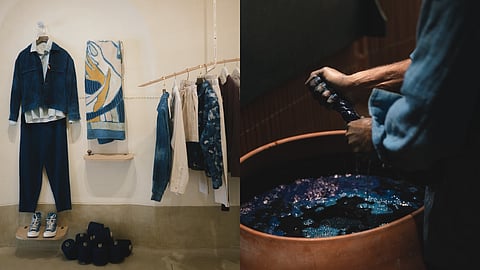
While in conversation with me, Himanshu frames this shift through the lens of what came before. “We call our Okhla space BASEMENT,” he says, describing it as an experiential environment where the product is conceived and developed. “It became a destination for those already familiar with 11.11 and curious to engage more deeply with our process.” The Lodi store, in contrast, opens that world up. “BASEMENT was our first child… the Lodi Colony flagship builds on that learning,” he adds, noting how the space naturally evolved into three parts-“the front introduces the collection, the central passage becomes an indigo experience, and this then leads into the made-to-measure glass room.”
Rather than feeling like distinct sections, this is more like a guided journey - an intentional movement through the brand’s universe. Even in how the store is conceived, there’s a clear resistance to the idea of retail as pure display. The focus stays on material and process, and in letting the pieces exist without excessive framing. This approach extends into how the space was built. Himanshu speaks about it as a collective effort rather than a singular vision. This way of working that he mentioned mirrors the brand itself, which has always relied on close collaboration with artisans and local communities.
“I’ve worked across disciplines with architects, product designers, exhibition designers, and lighting designers. Having the right people involved—and respecting each discipline for its expertise—is what allowed the store to become what it is today.”
Shani Himanshu, Co-Founder and Designer, 11.11
Material choices for the Lodi Colony story also follow the same line of thinking as he did in working with people. The store incorporates alternatives to conventional materials - boards made from agricultural by-products like mustard and sugarcane alongside materials like bamboo, lime, brass, and terracotta. It’s a continuation of 11.11’s long-standing position that sustainability isn’t an add-on or afterthought, but conscious decisions made every step of the way.
The indigo passage, in particular, is a focused presentation of the brand’s identity. Indigo has long been central to 11.11’s practice, and here it appears not just as a colour or a dye, but as a process - with living vats placed within the space. It’s a quiet but pointed reminder that what we often see as finished garments are actually part of an ongoing cycle of making.
At the end of the journey through the Lodi store is the Made-to-Measure room, designed as one for conversation rather than just sales. It reflects a deeper engagement with the visitor. What’s perhaps most telling of this element that I took away is how Himanshu describes the timeline of building the store. “The initial concept came together fairly quickly,” he says, “but the real time lies in refinement… responding to constraints, evolving through conversations.” It’s a sentiment that feels consistent with everything 11.11 has stood for—where the idea is only ever the starting point, and the real work lies in the slow, often invisible process of getting it right. So in the Made-To-Measure room, their patron isn’t just given pieces for trial, but to try on what feels right to them as people.
After reading about the Lodi Colony store and the interaction with Himanshu, it is evident how it is a true extension of the brand’s ongoing dialogue between material, memory, and making, rather than a store. It holds space for the garments, for the processes behind them, and for the many hands that have shaped 11.11.
You can follow the brand here.
If you enjoyed reading this, here's more from Homegrown:
Less Is More: 5 Homegrown Labels Redefining & Elevated Basics & Everyday Wear
echos above's Debut Sneaker Drop Brings Indian Craft To British Terrace Culture
How p é r o Turned Their Runway Into A Playground of Music, Craft and Comfort At LFW ‘26
