
- HOMEGROWN WORLD
- HGCREATORS
- HGEXPLORE
- HGVOICES
- HGSHOP
- CAREERS
- ABOUT US
- CONTACT US
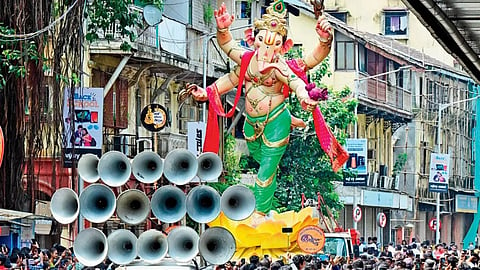
As we gear up for Ganesh Chaturthi, the annual conversation around festival noise is growing louder. While public Ganeshotsav was originally envisioned by Bal Gangadhar Tilak as a tool for community unity and political mobilisation, today's celebrations are increasingly defined by towering DJ setups and prolonged high-decibel sound. With studies showing Visarjan noise levels regularly crossing safe limits and authorities beginning to enforce stricter regulations, citizens are asking whether devotion and public health can coexist.
As Pune gears up for Ganesh Chaturthi on September 14th, the familiar rhythm of the festival returns with the excitement of bringing Bappa home. But so does another familiar rhythm: the thump of DJ speakers outside sarvajanik pandals that don't let up for ten straight days. It's time we talked about it honestly, without treating the conversation as an attack on faith or tradition.
It's worth remembering how this festival became public in the first place, becasue Ganeshotsav as a community event wasn't always this way. Bal Gangadhar Tilak transformed it in 1893 from a private household ritual into a public celebration precisely to bring people together under British rule, when open political assembly was banned. The pandal was a workaround for unity and a way to build collective identity during the freedom struggle. And somewhere along the way, the DJ set and the sheer volume of noise has become an integral part of the festival, and that's worth questioning, because traditions have always evolved with the times, and this generation gets to decide what that evolution looks like too.
COEP Technological University has monitored noise during Visarjan for 25 straight years, and even in 2025, the "quietest" year in the post-Covid period, the average sound level during the immersion procession was 92.6 dB, with peaks touching 109–111 dB at spots like Khanduji Chowk and Kunte Chowk. Experts note that sustained exposure above 90 dB can cause irreversible hearing damage, and this isn't a five-minute spike, it's hours at a stretch, day after day, for the young, the elderly, and anyone with a heart condition living within earshot.
And the people are pushing back. In Pune, The Police Commissioner recently warned mandals against plasma speakers and pressure-mid units. The NGT's 2024 order, which activists are now demanding be actually enforced, calls for decibel readings to be displayed publicly near mandaps and for DJs to be banned during immersion processions altogether. Citizens have marched from Abhinav Chowk to Shaniwar Wada demanding stricter limits, while sound-system operators themselves have offered a compromise: capping speaker stacks, banning laser, and pressure equipment, while resisting a blanket ban. None of it is settled yet, but the fact that it's being negotiated at all is progress.
What strikes me most, though, is how unevenly this is felt. I live in Baner when I'm in Pune, and honestly, I barely register the festival's noise beyond the odd procession passing by. But talk to anyone in the peths: Shaniwar Peth, Budhwar Peth; the older, denser parts of the city where mandal density is highest, the noise is an inescapable ten-day siege that peaks unbearably during the final two days of Visarjan, when processions can stretch on for over 24 hours. The newer, spread-out parts of Pune simply don't carry the burden that the historic core does.
And as we go into the latter part of this year and more festivals come upon us, across faiths, it's important to note that these occasions are cause for celebration and togetherness, but never at the expense of someone else's safety or well-being. So this festive season, let's be a little more considerate and try to regulate our decibels, because loving Bappa and loving your neighbour's eardrums aren't mutually exclusive.
