
- HOMEGROWN WORLD
- HGCREATORS
- HGEXPLORE
- HGVOICES
- HGSHOP
- CAREERS
- ABOUT US
- CONTACT US

This Pride Month, we are revisiting the histories of hijras, khwajasaras, intersex communities, transgender identities, and the Urdu literary traditions of women loving women, and exploring how colonial laws reshaped the region’s understanding of gender and sexuality.
The Great Uprising of 1857 was the first nationwide resistance movement against the British Raj in India. A hundred years after the Battle of Plassey marked the beginning of British rule in India, and ninety-three years after the Battle of Buxar (1764) cemented it, the entire nation seemed ready for rebellion. As the fire of resistance spread from Barrackpore in Bengal towards Delhi, courtesans and eunuchs — known as ‘tawaif’ and ‘khwajasara’ in Mughal India — became unlikely heroes of the Uprising. They provided hideouts, served as spies, and funded rebels against the British.
As a result, these communities were persecuted when the rebels lost. Following the 1857 mutiny, the British administration transitioned from East India Company rule to direct control by the British Crown, imposing a rigid Victorian morality. In 1871, they passed the notorious ‘Criminal Tribes Act’, which branded entire Indian communities — including the ‘hijra’ (intersex) and ‘khwaja’ (eunuchs) — “innately criminal”, effectively subjecting them to extreme prejudice, state surveillance, forced registration, and separation from mainstream Indian society.
Part II of the Criminal Tribes Act was explicitly titled ‘Eunuchs’, and it legally mandated the compulsory registration of the names, property, and residences of all hijras or khwajasaras suspected of sodomy. The law criminalised their cultural livelihood, making it a punishable offence for a registered ‘eunuch’ to appear in female clothing, dance or play music in public, or hold custody of children. This legal framework effectively stripped them of civil identity, property rights, and social legitimacy.
Precolonial South Asia was never a queer utopia. Gender and sexual minorities faced stigma, exclusion, and oppression. But they also occupied recognised social spaces that were neither entirely accepted nor rejected. The flexibility of these arrangements varied across regions, classes, religions, and historical periods, but they offered space for identities that colonial law sought to criminalise.
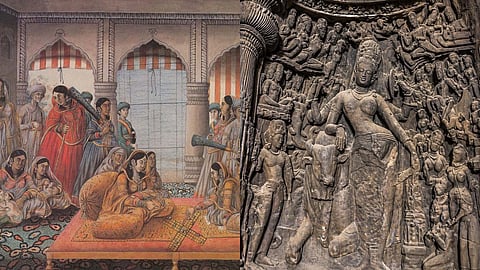
The most prominent example of this is the hijra community. For centuries, hijras occupied a distinctive social role across much of present-day India, Pakistan, and Bangladesh. Their presence is documented in court records, travelogues, religious traditions, and vernacular literature. Under the Delhi Sultanate, and later the Mughal Empire, many gender-nonconforming people and eunuchs, or castrated men, served as court officials, military commanders, guardians of royal households, and trusted administrators. Often referred to as ‘khwajasaras’ they could weild considerable political influence — some rose to positions of immense power, acting as diplomats, advisers, and even governors.
The categorisation of ‘khwajasara’ itself was complex. It encompassed eunuchs, or castrated men, and gender-nonconforming individuals alike, but it cannot be neatly mapped onto modern understandings of transgender identity. What matters is that these queer figures occupied a recognised place within premodern Indian political and social life instead of existing solely as objects of criminal suspicion.
South Asian religious traditions also contained spaces for gender variance. Hindu texts and myths include numerous examples of gender transformation and fluidity. The deity Ardhanarishvara combines Shiva and Parvati into a single androgunous form. Stories of Shikhandi and Chitrangada from the Mahabharata, and Mohini — Vishnu’s female avatar — complicate rigid notions of sex and gender. These narratives did not necessarily translate into social equality, but they provided precolonial and decolonial vocabularies and frameworks through which South Asians could understand gender nonconformity, which the colonial authorities criminalised and penalised.
Similarly, Islamic societies in South Asia accomodated a range of queer identities that existed outside modern binaries. While Islamic jurisprudence often regulated sexuality and gender expression, it also recognised categories beyond simple male-female distinctions. Intersex people, known in Arabic legal traditions as ‘khuntha’, occupied a recognised legal category requiring specific jurisprudential considerations. Sufi traditions, meanwhile, often embraced forms of devotions and embodiment that blurred conventional boundaries of gender and desire.
Colonial authorities viewed these ambiguities with alarm. The same period that saw the criminalisation of hijras also witnessed the introduction of Section 377 of the Indian Penal Code in 1860, which outlawed “carnal intercourse against the order of nature". Imported from British legal traditions, the law transformed certain sexual acts into crimes regardless of how they had previously been understood locally. Diverse practices and identities that had once occupied socially negotiated spaces were recast as signs of sexual deviance.
South Asia was never perfectly tolerant of queerness. But revisiting the region’s history of queerness reveals that contemporary debates over gender and sexuality are not a clash between “traditional Indian values” and modern queer identities. Many of the identities now portrayed as foreign imports were present in South Asia long before colonial rule. What colonialism introduced was not queerness, but a legal and moral framework that sought to render queer modes of desire and even existence illegitimate, criminal, and invisible.
