
- HOMEGROWN WORLD
- HGCREATORS
- HGEXPLORE
- HGVOICES
- HGSHOP
- CAREERS
- ABOUT US
- CONTACT US
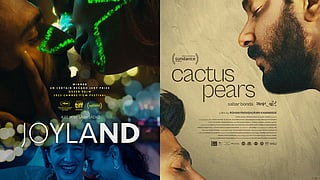

Queer South Asian cinema has evolved dramatically over the past two decades. From ‘Memories in March’ and ‘Chitrangada’ to ‘Joyland’, ‘Sabar Bonda’, and ‘Elephants in the Fog’, these films explore love, identity, family, gender, and belonging across India, Pakistan, Nepal, and the South Asian diaspora.
Queer lives in South Asia have always existed at the margins of mainstream society — equally celebrated and reviled in both imagined and real lives in the region. From queer characters in the Indian epic Mahabharata to royal eunuchs in the Mughal court, queerness has always existed at a threshold between acceptance and ostracisation in South Asia.
Over the past two decades, however, a growing body of films from across the region has begun to tell more nuanced stories about queer desire, gender identity, family, and belonging in India, Pakistan, Nepal and beyond. These films move beyond questions of visibility alone to explore the everyday realities of queer life in the region: the weight of social expectations, the complexities of kinship, the search for intimacy, and the possibility of selfhood in societies shaped by tradition, religion, and patriarchy.
From intimate family dramas and rural love stories to character studies of trans experience and gender nonconformity, these films reflect the extraordinary diversity of South Asian queer lives. Together, they offer a powerful cinematic portrait of a region where queer communities continue to create spaces for love, resilience, and joy against great odds.
‘Memories in March’ follows Arati, a grieving mother navigating the sudden death of her son Siddharth when she discovers aspects of his life he had never shared with her — especially his homosexuality. Written by Rituparno Ghosh, directed by Sanjoy Nag, and anchored by a remarkable performance from Deepti Naval, the film is a meditation on grief, acceptance, and strange experience of getting to know one’s adult offspring after their death.
Inspired by Rabindranath Tagore’s ‘Chitrangada’, itself a retelling of an episode from the Mahabharata, ‘Chitrangada: The Crowning Wish’ is perhaps queer Bengali auteur Rituparno Ghosh’s most personal film. ‘Chitrangada’ stars the filmmaker as Rudra, a queer choreographer confronting questions of gender identity, love, and bodily autonomy while staging an adaptation of Tagore’s dance-drama. As Rudra considers gender-affirming surgery, the boundaries between theatre, myth, and their tlived experience blur. ‘Chitrangada’ is arguably one of Indian cinema’s most nuanced explorations of gender nonconformity, artistic creation, and the longing to be seen as one’s authentic self.
Set in a conservative South Indian town bound by tradition and social convention, ‘Evening Shadows’ follows Kartik (Devansh Doshi), a young gay man who comes out to his mother, Vasudha (Mona Ambegaonkar). The revelation upends her understanding of the world and leaves her grappling with fear, confusion, and uncertainty. With few people around her willing or able to help her make sense of her son’s truth, Vasudha finds herself increasingly isolated. As a woman navigating a deeply patriarchal social order, she must also confront the hostility of her conservative husband, Damodar (Ananth Mahadevan), and the judgment of the community around her.
Adapted from Sachin Kundalkar’s acclaimed novel of the same name, ‘Cobalt Blue’ centres on a brother and sister who both fall in love with the same enigmatic paying guest. As desire, obsession, and heartbreak reshape the household, long-suppressed emotions surface. While its narrative sometimes feels restrained compared to the novel’s psychological depth, ‘Cobalt Blue’ remains a compelling exploration of queer desire and emotional vulnerability in Indian Cinema.
The first Pakistani feature film to screen at the Cannes Film Festival, ‘Joyland’ follows Haider, a soft-spoken man from a conservative Lahore family who secretly takes a job at an erotic dance theatre and falls in love with Biba, the transgender star performer. In ‘Joyland’, director Saim Sadiq crafts a layered portrait of desire, gender, and familial obligation. Refusing simplistic binaries, the film examines how patriarchy constrains everyone it touches. ‘Joyland’ is both a tender love story and a sharp critique of conservative social norms, marking a watershed moment for queer representation in Pakistani cinema.
When an aspiring politician becomes embroiled in a divorce case, long-buried truths about his sexuality begin to emerge. Directed by Jeo Baby and featuring one of the finest performances of Mammootty’s career, ‘Kaathal: The Core’ approaches its subject with uncommon maturity and compassion. Instead of framing queerness as scandal, the film focuses on the emotional costs of silence, social conformity, and unfulfilled lives. ‘Kaathal’ stands out as a landmark in Indian cinema’s engagement with queer experience and desire later in life.
Set in rural Maharashtra, ‘Sabar Bonda’ (Cactus Pears) follows Anand, a young man mourning the death of his father while navigating an increasingly complex relationship with Balya, a farm worker employed by his family. As grief, desire, and social expectations collide, the two men find themselves negotiating forms of intimacy rarely depicted in Indian cinema. The film’s observational style and rural setting offer a refreshing departure from urban queer narratives. At once radical and humane, ‘Sabar Bonda’ captures the fragility of connection amid changing social realities, establishing itself as one of the most significant recent additions to India’s growing body of queer cinema. Written and directed by Rohan Parashuram Kanawade, the film made history at the 2025 Sundance Film Festival by winning the World Cinema Grand Jury Prize Dramatic.
Adapted from a stage play of the same name, ‘A Nice Indian Boy’ follows Naveen, a shy Indian American doctor whose carefully ordered life is disrupted when he falls in love with Jay, a charismatic white photographer adopted by Indian parents. What follows is a warm, often hilarious exploration of family expectations, cultural identity, and queer romance. Unlike many coming-out dramas, the film foregrounds joy, awkwardness, and community rather than conflict alone. Its charm lies in its affectionate portrayal of diasporic life and the belief that love can create unexpected bridges across difference. The result is a delightful and emotionally generous romantic comedy.
Set in Thori, a small village in Nepal’s southern Terai plains, the film follows a community of transgender and intersex women living at the edge of a society that rejects them. The film’s protagonist Pirati is a matriarch of the Kinnar community, whose dreams of escaping this ostracism with the man she loves are shattered when one of her daughters goes missing.
‘Elephants in the Fog’ won the Un Certain Regard Jury Prize at the 79th Cannes Film Festival. It was a watershed moment for the Nepali cinema, which has long existed on the margins of the global film circuit. It was also the first Nepali production ever to be selected for the Un Certain Regard section, which runs in parallel with the main competition for the Palme d’Or.
If you enjoyed reading this, here’s more from Homegrown:
From ‘Funny Boy’ To ‘Walk Like A Girl’: 12 Essential Works Of South Asian Queer Literature
Queer Health, Polyamory, Drag, & Theatre: A Homegrown Guide To Pride 2026 In India
Pride: An Experimental Short Film Exploring The Realities Of Forbidden Love
