
- HOMEGROWN WORLD
- HGCREATORS
- HGEXPLORE
- HGVOICES
- HGSHOP
- CAREERS
- ABOUT US
- CONTACT US

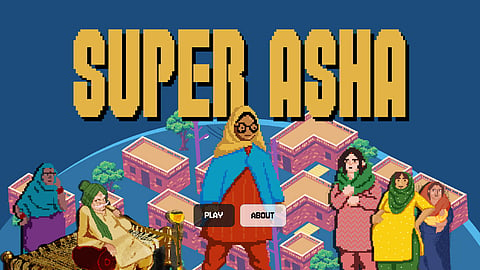
Super ASHA is a web-based game created by filmmaker and feminist technologist Priya Goswami as part of her Mozilla Fellowship. Based on research and real accounts from ASHA workers in India, it puts players in the position of a community health worker navigating unpaid domestic labour, family hierarchies, difficult healthcare decisions, and the growing demands of digital data collection. The game examines the gendered exploitation of care work and the human costs of India's expanding digital healthcare systems.
The internet has done women a disservice in more ways than one, be it conservative trad-wife narratives, the sexism of the manosphere or the resurgence of extreme thinness through SkinnyTok, but with the advent of AI, the use of technology in misogynistic ways has increased twofold. From deepfakes that digitally undress women to male creators generating sexually suggestive female characters for content, technology is giving misogyny new ways to flourish. Even during recent protests in India, right-wing groups manufactured fake videos of women wearing revealing clothes to discredit their participation. Across these scenarios, questions on gender and technology have long been inseparable, and feminist technologist Priya Goswami has spent much of her work examining this relationship. A filmmaker and feminist activist, Priya builds technology around the lived experiences of women and marginalised communities, questioning whose interests digital tools serve and whose safety they protect.
Her Mumkin App, for example, uses an AI chatbot that plays fictional characters, such as a mother or husband, so users can rehearse how to raise sensitive topics like female genital cutting, consent and domestic violence before having those conversations in real life. She is also a co-founder of Sahiyo, an organisation working to end female genital cutting, and her documentary 'A Pinch of Skin, which examined the practice in India, won the National Film Award in 2013.
Super ASHA, her latest project, is a web-based game Priya created as a Mozilla Fellow that puts players in the position of an Accredited Social Health Activist, or ASHA worker, part of India's all-women community health workforce. These workers visit households, support pregnant women, track vaccinations, follow up on maternal, and child health, and connect communities with public healthcare services. Their work also increasingly involves collecting and uploading health information through digital systems. Super ASHA asks players to experience a day in this job, beginning with familiar video-game mechanics that recall Super Mario before moving into situations where every decision has consequences. The game draws on field research and real accounts from ASHA workers in Haryana and elsewhere in India. Its development team includes visual designer Ranjitha Rajeevan, animation lead Basim Abu, alongside other artists and researchers.
A typical day for Asha, the game's fictional protagonist, begins at five in the morning and can stretch until midnight. Between household visits, she must navigate family dynamics, persuade hesitant relatives to seek medical care, and find ways to speak privately with women who may be unable to discuss their health in front of husbands or elders. A conversation about a newborn's health, for example, can raise questions about a possible death in the family, while a high-risk pregnancy can become a struggle to convince relatives that hospital care is necessary. These decisions are complicated by the information Asha is expected to collect. What should she record on a government portal? How might that information affect a household later? And what happens when the people sharing sensitive details have little knowledge of where their data will go? The game makes players deal with these questions while keeping up with the demands of the working day.
As an ASHA worker, your day starts with household chores you don't earn any XP for — a reminder of how women's domestic labour is taken for granted even when they have demanding jobs of their own. Then you step outside and have to navigate traffic just to get to work, coming to terms with how pedestrian-unfriendly most Indian cities are. Once you reach the families you're supposed to help, the job requires a whole other set of social skills: navigating family hierarchies, gender dynamics, health-related stigma and people's fears and suspicions before you can even begin to help them. It touches on arguably one the biggest criticisms of the left — that we can become so caught up in getting the politics right that we alienate potential allies, forgetting that changing minds requires meeting people where they are. The game also makes perceptible the emotional toll this work can take, like losing a life point when you hear about an infanticide.
“ASHA workers hold the inner lives and secrets of people who they go and meet on a day-to-day basis,” says Priya who has come across many stories of impossible choices they have to make, like having to choose between saving a mother and keeping access to a family. One that she will never forget was shared by a young ASHA worker in Haryana who had visited a pregnant woman earlier and told her that she needed to go to the hospital as soon as possible. When she returned, she walked into a pool of blood, with the woman bleeding out after delivery and her newborn lying naked on the floor beside her.
“These kind of stories are very graphic and very difficult to be gamified in a way where it doesn't sensationalize someone’s trauma,” shares Priya, but that’s been her work now as an artist. The aim with Super ASHA was to bring the player to the point of the moral dilemma an ASHA worker might face during an ordinary workday. The game is still being developed, with three or four more levels planned, and she hopes to bring stories from the hinterlands and rural parts of the country to players as moral choices that they must make and face the consequences of.
Priya says there are many systemic barriers that need to be addressed for ASHA workers, including the need for mental health support. During her documentary work with ASHA workers in Haryana, she found that once filming stopped and everyone relaxed, the workers began asking for a survey to assess how their mental health was faring. They wanted someone to ask whether they were doing okay and to ‘measure the depression’ and work-related trauma they experience. A mental health assessment, Priya tells us, is crucial for the kind of trauma ASHA workers go through in their day-to-day lives.
When the team was initially developing the game, Priya had named it Super Seva Agent, because the concept of ‘seva’ or service is deeply tied to the exploitation of women's labour. ASHA workers are expected to provide this service without being fairly compensated for their work because it is assumed to be their ‘duty’ as a woman. “Which man would go door-to-door and work for so many hours a day; take on so many challenges? Would it be acceptable to pay that man under 10,000 rupees, or 8,000 rupees, even less in come cases?” Priya asks.
Now, 21 years into the ASHA programme, the concept of who an Asha worker still comes from really extractive ideas in so far as the government framing ASHA workers as an "all-woman cohort that can impart seva". “Because who can a pregnant woman or a child turn to if not another woman?” states Priya. ASHA workers are often seen as community-based ‘didis’ (elder sisters) who can ‘make someone's day’ or offer the kind of personal advice another woman may not feel comfortable discussing with a male doctor. Priya points out the many nuances in how institutions frame ASHA workers as seva agents, and explains that the game was eventually named Super ASHA partly to have the recall value of Mario, who jumps towards Princess Peach. In the game, Asha's invisible labour and exhausting, 24-hour workload become the obstacles she has to keep jumping over, hour after hour.
If you enjoyed reading this, here's more from Homegrown:
A Video Game Set In A Fictionalised Kerala Is Challenging The Way We Think About Activism
'Silkgrove': An Indian Solarpunk Video Game That Places Restoration At The Centre Of Play
Mukti: A Pathbreaking Indian Video Game Exploring The Grim Reality Of Human Trafficking
