
- HOMEGROWN WORLD
- HGCREATORS
- HGEXPLORE
- HGVOICES
- HGSHOP
- CAREERS
- ABOUT US
- CONTACT US
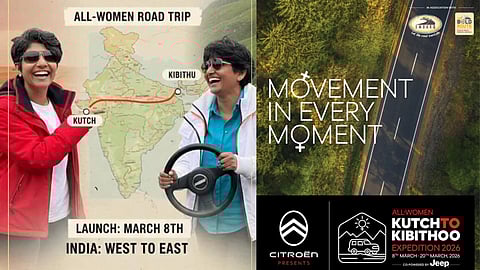
Embarq's K2K 2026 is a 20-day, 4,000-plus kilometre all-women self-drive expedition launching on International Women's Day (March 8), taking a convoy of over 40 women from Bhuj in Kutch, Gujarat, through Jaipur, Lucknow, Patna, Siliguri, Guwahati, and Itanagar, all the way to the remote frontier town of Kibithoo in Arunachal Pradesh. The K2K expedition is fully supported with logistics, walkie-talkies in every car, rest stops every two hours, and pre-mapped medical and breakdown assistance points, striking a balance between a genuinely demanding drive and an organised, accessible experience the idea being that the convoy's visibility through cities and small towns is itself a cultural statement.
There is a persistent cultural bias against women drivers, and in India it shows up in quietly specific ways. Women are questioned about their routes, advised against highway driving after dark, and offered unsolicited opinions about parking and lane discipline. The assumption is that the open road is male territory. Long-distance self-driving, especially solo or all-women, sits at the sharpest end of that discomfort. Embarq's Bold Route Series is designed as a direct response to that dynamic.
The company's latest expedition, K2K 2026, runs from Bhuj in Kutch, Gujarat, through Jaipur, Lucknow, Patna, Siliguri, Guwahati and Itanagar, before ending at Kibithoo in Arunachal Pradesh, one of the most remote points on India's map. It's a 4,000-plus kilometre drive, averaging around 400 kilometres a day, for a convoy of over 40 women.
Medha Joseph and Sujal Patwardhan founded Embarq in 2015, following a colossal 23,000-kilometre drive from India to Morocco. That journey became the foundation for what is now a self-drive expedition company operating across more than 30 countries.
The Bold Route Series, launched last year, is their newest offering. Their 2025 Kashmir to Kanyakumari drive brought together more than 50 women across 25 cars, one of the largest all-women self-drive convoys in India's history. K2K 2026 continues eastward from there, into terrain that most travellers haven't visited.
The expedition is fully supported, logistics, safety infrastructure and route planning are all handled by the Embarq team. Medha Joseph says she and Patwardhan personally recced the entire route, identifying rest stops every two hours, mapping medical centres, service stations and breakdown assistance points along the way. Each car is equipped with a walkie-talkie for convoy communication. "This is where a decade of experience managing convoys on road trips in India and abroad comes in handy," she said.
The structure matters because the conversation around women and adventure travel tends toward two extremes, either stripping everything back to prove a point, or adding so much support that the adventure becomes largely symbolic. Embarq's approach sits between those positions. The drive is demanding in distance and terrain, but organised so participants can focus on the experience rather than logistics.
Joseph says the impact of these expeditions tends to go beyond driving. "Women love the freedom they experience, expeditions like these are liberating. The way your perspective broadens through experiences like these, sometimes through meeting women from very different walks of life and understanding their stories, is something we hope more women get to feel."
On the wider cultural question, Joseph sees Embarq's role as dismantling barriers logistical, psychological and social. "When a convoy driven entirely by women passes through cities and small towns, it naturally turns heads and sparks curiosity and conversations." The visibility, she says, is part of the point.
The Kutch To Kibithoo 2026 expedition is planned from March 8 to 28. Head to the Embarq website to learn more.
If you enjoyed reading this, here’s more from Homegrown:
Beedi Wars: How The Humble Beedi Sparked Decades Of Bloody Conflict In Kerala & Karnataka
Why Is A High School In Hungary Named After Dr Ambedkar?
Abbey 301: How A 200-Year-Old Chapel In Khandala Found Its Artistic Voice

