
- HOMEGROWN WORLD
- HGCREATORS
- HGEXPLORE
- HGVOICES
- HGSHOP
- CAREERS
- ABOUT US
- CONTACT US
At Bengaluru’s Nila, Chef Rahul Sharma’s latest tasting menu, Backwaters, turns Kerala’s culinary landscape into an immersive 12-course experience. Through indigenous rice varieties, coastal ingredients, preservation techniques, and deeply familiar flavours presented in unexpected forms, the menu explores how geography and ecology shape Indian cuisine from across the country.
I love rice. If I could eat rice every day for every meal, I would live a very happy life. My death row meal would be deceptively simple: a world-class bowl of rasam poured generously over hot rice, with cold curd on the side. And yet, for something so central to Indian life and my life, I never fully realised just how distinct and varied rice’s topography across the country truly is.
That was until I met Chef Rahul Sharma, of Bengaluru’s Nila. He broke it down to me explaining to me how diverse rice is. The rice of one region is rarely the rice of another. The short, red, nutrient-rich grains cultivated in Kerala’s flooded backwaters carry an entirely different personality from the fragrant, delicate varieties of the north or the sticky indigenous grains grown in the Northeast. Some are floral, some earthy, some intensely mineral.
And at Nila, his chef-led restaurant in Bengaluru, cuisine is approached as an archive of geography and ingredients; as a way of understanding India through the landscapes that shape how people cook and eat.
With a new chapter every three months, each edition is designed to honour a particular Indian culinary region. This May, Nila enters the second chapter of its culinary journey, turning its attention from the hills and smoke of Nagaland to the layered ecology of India’s southern backwaters.
In a conversation with me about the reason behind choosing the Kerala backwaters as Nila’s next chapter, Chef Rahul Sharma said, “India is a peninsula surrounded by water on three sides, and that heavily influences the way we eat. We wanted to shine a light on those traditions through this chapter.”
"I didn’t want to take pre-existing dishes from these regions and simply present them to diners, because that would imply the originals weren’t already perfected or somehow needed reinterpretation. The goal is to highlight the ingredients that form the foundation of these cuisines and make them so different."
Chef Rahul Sharma, Nila
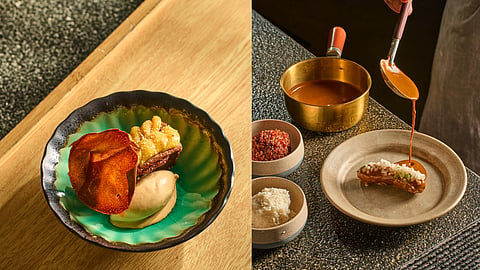
Titled 'Backwaters', the new 12-course tasting menu, draws from Kerala’s agricultural and coastal landscapes, and reads almost like a map of the region’s ecology. Everything from rice (obviously), coconut, limes and mangoes are the heroes on Nila’s Backwaters menu.

The meal begins with an introduction to the terrain with the omnipresent staple seen across Kerala: the coconut. It appears in layered textures with every part of the fruit complete with curry leaf and fresh herbs. What struck me the most was how similar the dish tasted like a marriage of the first salad served in a banana leaf meal and ‘moru curry’, the flavours reminding me of foods I’ve been eating for forever in a completely different light.
As the courses progress, preservation techniques begin to quietly anchor the narrative. Pickling, fermentation, curing, and gentle charring become recurring techniques, highlighting food traditions woven into Kerala’s culinary culture.
Mixing ingredients together to create something deeply rooted yet vividly unique shines through across the twelve courses. A soup of drumstick meat, duck, and peas arrives in the meal. It's so savoury and unlike anything I've tasted before, but it's something I was able to guzzle down like a glass of hot rasam. On the other hand, karimeen is served atop a savoury pancake, submerged in a fragrant fish broth that transforms the dish entirely. I have eaten a lot of fish in my life, but never have I eaten fish served on a pancake, and never in my wildest dreams would I expect it to work together so well.
Nila continuously builds a world that gives you context about where what you're eating comes from, while presenting it in a way that deepens your curiosity about the elasticity and potential of these ingredients through the forms they take on the plate in front of you.
And coming back to rice, indigenous varieties like Navara, Gandhakasala, and Kalipad appear across the progression in varied forms, bringing distinct textures and fragrances to the meal. One of the courses stars is the rice paired with an Alleppey pepper pork sausage and a molé-like chocolate sauce. (I know what you're thinking: chocolate, pork, and rice sounds strange, to say the least, but trust me.) The dish is smoky, sweet, and spicy all at once, balancing seemingly contrasting flavours with surprising ease. The rice acts as an anchor, grounding the richness of the sausage, while the sauce ties everything together, creating a complexity without any of the elements overpowering each other.
It also leans into one of India’s most enduring culinary traditions: condiment culture. Its bread course pairs in-house sourdough topped with toasted potatoes with an array of accruements. From a tamarind chutney that took me back to licking my grandmother's 'kai rasa' off the plate to a yoghurt dip peppered in with chillies, the table became reminiscent of every Indian home.
Across all 12 courses, the underlying philosophy remains consistent. Ingredients evolve through technique, and familiarity is preserved, even when presentation shifts. If Chapter One at Nila explored Nagaland through smoke and fermentation, Backwaters expands the restaurant’s larger conversation around regional Indian cuisine, one that prioritises landscapes and food systems, over simplified ideas of authenticity.
And through this evolving series of menus, Chef Rahul Sharma’s goal with this tasting menu is to honour the miniscule details of the food and to ask the diners to look closer at the ingredients they thought they already knew and be curious about them in their new forms.
Follow Nila on Instagram.
