
- HOMEGROWN WORLD
- HGCREATORS
- HGEXPLORE
- HGVOICES
- HGSHOP
- CAREERS
- ABOUT US
- CONTACT US
Migration from not just India, but across the world, has always been shaped by a mix of necessity, ambition, and imagination. Historically, Indians moved beyond the subcontinent as traders along ancient sea routes, as indentured labourers under colonial rule, and later as students, professionals, and workers seeking stability, opportunity, or dignity that often felt out of reach at home. These journeys were rarely about leaving Indianness behind, but about the hope for a better and more comfortable life. In moving outward, Indians carried language, food, memory, faith, and cultural instinct with them, reshaping what it meant to be Indian across borders.
This movement created an archetype in both pop culture and social memory: the NRI. An Indian who is considered somewhat Indian because they like eating butter chicken, yet also an Indian whose mother tongue is marked by rolled Rs. An Indian who learns most of what they know about Indian culture from Karan Johar films, but is seen as completely out of touch with what contemporary India actually looks like. No matter what they do, they are often perceived as a half-assed version of what someone belonging to this country is expected to be.
But beyond these stereotypes, what we often refuse to see is how the diaspora actively forms its Indianness as well as what informs it and sustains it. For many first-generation immigrants, their understanding of where they come from is inherited rather than experienced, passed down through parents who carry memories of the India they grew up in. This version of India is built from stories and anecdotes of a place frozen in time, an India shaped by nostalgia rather than immediacy. What travels across borders is not the country as it exists now, but the emotional residue of a homeland remembered and selectively preserved. For many, the connection to India has never been about geography, but about emotion. As contemporary India continues to evolve in ways they may never fully witness firsthand, the diaspora’s sense of Indianness becomes an identity that is deeply rooted, yet temporally displaced.

The diaspora is more often than not clubbed into a single jumbo category of ABCDs: American Born Confused Desis. But diasporic identity is neither singular nor static; it exists on a spectrum shaped by history, class, migration patterns, and proximity to the homeland. This identity walks a tightrope between two worlds that both feel partially out of reach. In their countries of residence, diasporic individuals are often marked as perpetually foreign; too brown; too accented; too culturally different to be fully absorbed into ideas of whiteness or national belonging. Yet in India, they are frequently viewed with suspicion or ridicule, labelled as not Indian enough, their accents mocked, their cultural knowledge questioned, and their authenticity constantly measured against an imagined 'real' Indian. This in-between state produces a persistent sense of un-belonging, caught between assimilation and alienation.
This lack of acceptance inevitably shapes how diasporic artists are perceived as well. Because of the constant negotiation between belonging and exclusion, many struggle to root themselves fully in any one place, living with the feeling of being perpetually in transit. A lack of complete acceptance, both from the countries they inhabit and from the cultures they inherit, often leaves them creating from a space of fragmentation rather than certainty. Existing between worlds offers a vantage point that is both intimate and distanced, allowing them to question ideas of cultural purity and belonging. For them, culture is not a fixed inheritance but something porous and continually evolving. This liminal position encourages experimentation and results in work that resists easy categorisation. What may initially feel like rootlessness becomes a site of possibility, where hybridity is not a compromise but a creative strength—one that enables diasporic artists to articulate identities that are layered, fluid, and deeply reflective of a globalised world.
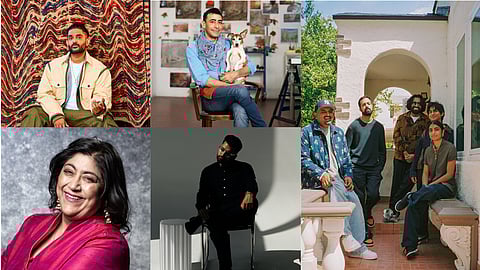
Artists like Sid Sriram, who was born in Chennai and raised in the Bay Area; Gurinder Chadha, a Kenyan-born British filmmaker of Indian origin; and D36, an independent Los Angeles–based music label amplifying South Asian voices, exemplify this nuanced diasporic expression. Without always stating it explicitly, they weave their artistry with a thread of Indianness that is deeply personal and unmistakably their own. In a country like India, where my lived experience and that of my neighbour can be vastly different, the idea of what it means to belong to this subcontinent has never been singular. We are, after all, the product of centuries of cultural intermingling that's reflected in the clothes we wear, the books we read, and the languages we speak. To label these artists and individuals as “un-Indian” simply because their version of Indianness differs from our own is not only unfair, but fundamentally misunderstands the fluid and plural nature of Indian identity itself.
When we move beyond flattening stereotypes and rigid ideas of authenticity, we begin to see the diaspora not as a lesser version of Indianness, but as one of its many living, evolving expressions. In acknowledging this, we make room for a more expansive understanding of what it means to belong to a culture and a country that has always been in motion.
If you enjoyed reading this, here's more from Homegrown:
In Conversation With Jessie Sohpaul: Diaspora, Caste, & Making Art That Refuses Comfort
In Defence of The 'Mango Diaspora’: Why Diasporic Writers Succumb To South Asian Clichés
The Unapologetic Authenticity Of Sid Sriram: Homecomings, Tiny Desk, 'Sidharth', & More
