
- HOMEGROWN WORLD
- HGCREATORS
- HGEXPLORE
- HGVOICES
- HGSHOP
- CAREERS
- ABOUT US
- CONTACT US
As streaming platforms reshape how films are made and watched, this piece explores what the shifting relationship between Indian audiences and movie theatres reveals about cinema today. Through personal memory, industry data, and audience voices, it examines how theatrical viewing is becoming more intentional — and what may be at stake when convenience begins to outweigh collective, immersive experiences.
The first distinct memory I have of going to a movie theatre is from when I was around 11 years old. For my birthday, my mum took me to watch 'Zindagi Na Milegi Dobara', a film that remained my favourite until I was about 17. I remember the collective gasp in the hall when Hrithik Roshan appeared on screen, and the anticipation that built as Katrina Kaif followed that blue convertible on her Bullet to profess her love. It felt deeply communal; possibly one of the most human experiences I had encountered at that age.
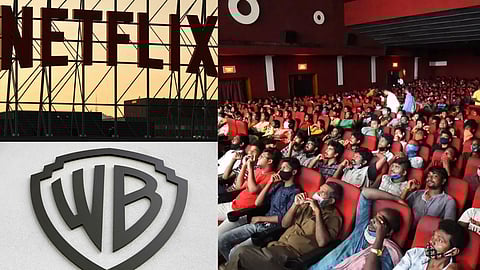
That sense of shared emotion inside a darkened theatre is what makes today’s shifts in the global film industry feel especially consequential. With the latest news about Warner Bros. being acquired by Netflix — a move that could change the game for theatrical releases and reshape how Hollywood content reaches audiences worldwide — conversations around the future of cinema have intensified. Beyond the U.S. market, the deal has raised important questions for countries like India. Netflix’s proposed acquisition of Warner Bros. Discovery would place a vast library of films, television series, and blockbuster franchises under a single streaming giant, consolidating a significant portion of Hollywood’s content creation and distribution ecosystem. This moment feels like a turning point — one where watching a film in a theatre is no longer a default habit, but a conscious choice.
In India, the implications are especially significant. Industry bodies like the Multiplex Association of India have raised concerns that fewer Hollywood films may receive full theatrical runs, affecting box office revenues and cinema footfalls. Warner Bros. has historically been a key contributor to India’s theatrical release calendar, with Hollywood films accounting for 15–20% of India’s gross box office collections. A Netflix-led strategy could prioritise direct-to-streaming releases, further shrinking the already narrowing theatrical window. Ultimately, while such consolidation could offer Indian audiences easier access to premium global content on a single platform, it also sharpens a growing tension between convenience-driven streaming models and the cultural and economic value of theatrical cinema in India
Since the pandemic, people’s relationship with movie-watching has begun to resemble modern dating. Multiplexes are the relationship you aspire to, but often don’t have the energy to commit to — because OTT platforms offer the convenience of a situationship. You switch them on when you want, pause mid-climax if you lose interest, and move on to the next option just as easily. And with Netflix CEO Ted Sarandos remarking, “What is the consumer trying to tell us? That they’d like to watch movies at home, thank you,” we wanted to understand what still draws Indian audiences to movie theatres. Is it the surround-sound spectacle of IMAX? The intimacy of being absorbed by a work of art? Or simply the joy of making an outing of it? Or do audiences now genuinely prefer watching cinema at home, on smaller screens?
To understand how this shift is playing out beyond industry boardrooms, we spoke to 15 individuals across age groups about their evolving relationship with movie theatres.
Kavya Sriram, a 21-year-old HR professional, believes that while streaming platforms have undeniably increased convenience, something essential is being lost. “I think streaming platforms have made things extremely convenient, which is a good thing, but for me the experience of watching a movie with the entire package of my senses being completely engaged — experiencing everything on a wider scale — can never be compared with watching something on my bed and dozing off midway. The consumer doesn’t want another reason to not engage their brain. Soon enough, we will be watching movies on reels or shorts because we’ve coddled our attention spans to convenience and comfort.”
As more of us, particularly in this generation, spend our days swiping from one piece of content to another, the ability to sit still has begun to feel like a lost art — one that cinema demands. The theatre creates a world around you, insisting on focus and presence, whereas streaming has increasingly normalised a passive mode of consumption where distraction is built into the experience.
Speaking in a similar vein, Mihika K, a 27-year-old IT professional, recalls a recent conversation with her father about choosing between theatres and OTT platforms. “Recently, when 'Dhurandar' was released, the OTT release date was announced for just a month later. I told my dad that we could simply watch it on Netflix instead of spending the money on theatre tickets. But he said that some movies demand the experience of being watched in a theatre with your family — that it’s less about the film alone and more about spending time together and making a complete day out of it. I realised that it’s only when a movie turns out to be extremely boring that you regret watching it in a theatre; otherwise, the experience rarely disappoints.”
Growing up, I remember the theatre as a community activity — trips with friends or cousins supervised by one parent, or family outings that felt ceremonial. I remember being captured by the screen as my cousins and I watched 'Top Gun: Maverick' and my mum whispered into my ears what the original film meant to her when she was my age. I remember my best friend and I clinging to each other as we sobbed through 'Homebound', both deeply moved and uncomfortably aware of our own privilege. Cinema was never just about the film.

The six people I spoke to from older generations shared a common thread: the belief that a theatrical experience is warranted only when a film truly demands it. As Srikanth K explains, “More than the cost, it is the hassle of commuting, traffic, parking, that is a barrier to going to cinemas. Therefore going to the theatre only makes sense if the movie has a compelling reason, like a ‘must watch on large screen’.” His observation reflects a broader shift in how audiences now approach cinema-going — not just as a routine leisure activity, but also, a deliberate decision weighed against effort and convenience.
These personal recalibrations are not isolated sentiments, but part of a larger behavioural trend. A Statista survey conducted in January 2025 revealed a 6% decline in cinema attendance compared to the previous year, even as movie ticket prices continued to rise. Together, these trends suggest that while theatres still matter, audiences are becoming increasingly selective about when (and why) they show up.
The stakes of this shift go beyond personal preference or nostalgia. When cinema becomes an intentional, event-only experience, it risks becoming more exclusionary than it already is. Smaller films and mid-budget experiments are often the first to be edged out of theatres, while spectacle-driven cinema thrives. In narrowing what is “worth” watching on the big screen, we also narrow who gets to occupy that space. And this is the central anxiety surrounding Netflix’s acquisition of Warner Bros. As streaming giants consolidate power, decisions about what deserves a theatrical life increasingly rest with platforms optimised for scale, data, and global reach rather than cultural specificity or risk-taking. The fear isn’t simply that fewer films will reach cinemas, but that the idea of cinema itself will be filtered through algorithms.
What emerges from these conversations and numbers is not the death of the movie theatre, but its redefinition. Cinema-going in India, and perhaps the world is clearly no longer habitual; it is intentional. Audiences are willing to endure traffic, cost, and inconvenience only when a film promises something that cannot be replicated on a phone or television screen.
And yes, for someone like me, this is quite heartbreaking. Because it means the quiet erosion of spontaneity — of deciding, on a whim, to walk into a theatre, simply to feel something. While this shift may ensure the survival of theatres in a convenience-first world, it also narrows what cinema once was: a democratic space where stories were encountered collectively, not strategically chosen. What we gain in comfort, we risk losing in community — and perhaps, in the long run, that is the most expensive 'ticket' price of all.
If you enjoyed reading this, here’s more from Homegrown:
'Silkgrove': An Indian Solarpunk Video Game That Places Restoration At The Centre Of Play
Raj, Simran, & The NRI Dream India Couldn’t Get Over: DDLJ In Retrospect
Gurinder Chadha Reflects On Her Legacy: From 'Bend It Like Beckham' To 'Christmas Karma'
