
- HOMEGROWN WORLD
- HGCREATORS
- HGEXPLORE
- HGVOICES
- HGSHOP
- CAREERS
- ABOUT US
- CONTACT US
An exploration of the history, regional diversity, and cultural weight of Indian draped menswear. The piece examines how unstitched textiles shaped traditional wardrobes and why contemporary designers are looking to the art of the drape to build a modern Indian fashion vocabulary.
I’ve always believed draping to be one of the most fascinating forms of design, which is probably why I’ve always loved sarees so much. The idea that the same six metres of fabric can be worn and presented in countless different ways and silhouettes depending on who’s wearing it, where they’re from, and how they drape it, is incredible.
I must admit, though, that I hadn't really thought much about draping in menswear until recently. Most of what I knew came from two friends. One learnt to pleat by watching his father tie dhotis and helping his mother drape sarees. The other often pulls up to our hangouts in the coolest veshti, polo shirt, and Birkenstock combinations, wearing them as effortlessly as most people wear cargos. Having them around made me realise I knew embarrassingly little about draped menswear, and that curiosity quickly turned into a bit of a rabbit hole.
Because long before rigid seams, darted shoulders and stiff collars became the norm, menswear across the subcontinent was built around draped clothing. The same length of fabric could be pleated, tucked and folded differently depending on the region, the weather, the occasion, the work at hand and the person wearing it.
To trace the roots of how Indian men dressed, one has to look past modern retail racks and examine ancient temple friezes, Ajanta murals, and terracotta figures. Across classical India, status and identity were often reflected in the quality, length and drape of a single piece of cloth. The Antariya (lower drape) and Uttariya (upper cloth) were central to how men dressed across ancient India.
Wearing unstitched cloth made practical sense; in places with heavy humidity and intense heat, seamless textiles let the skin breathe. People also associated unstitched fabric with ritual purity, believing that cutting and stitching cloth altered its natural form. Long before European tailoring arrived on trade ships, Indian men were already wearing clothes engineered around climate, movement, and the structure of handloom weaving.
Indian draped menswear never really existed as a single standard garment. What people call a dhoti today takes on multiple regional forms, shaped by local looms, climate, and daily routines.
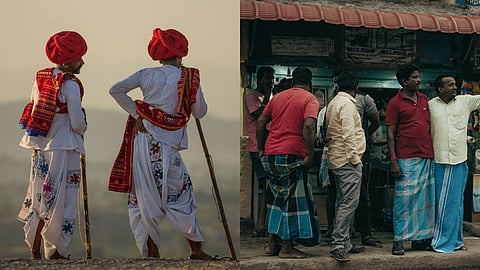
Down in Tamil Nadu and Kerala, the veshti and mundu feature a straight rectangular wrap. They usually come in white cotton with gold thread or colourful borders that handle tropical heat well. Across Karnataka and Andhra Pradesh, the panche uses front pleats that make walking easier. In Maharashtra, men pull the dhotar between their legs into a fitted drape called a kachha, which originally helped with riding horses and physical labour. The lungi, though often grouped with the dhoti today, followed its own trajectory as a tubular garment designed for comfort and everyday wear. Different regions developed their own draping styles, shaped by local customs and practical needs.

The structural cleverness of the dhoti comes down to pleat mechanics. The front folds create built-in fabric reserves, giving the wearer complete mobility without placing tension on any single thread.
Farmers and artisans working outside hitched the cloth up above their knees, securing the excess fabric around the waist to keep their legs clear of mud and tools. Scholars, merchants, and court officials pulled the gathers lower, letting the cloth fan out towards their ankles. The wider display of the loom border also became a subtle way of signalling status. The garment functioned equally well in fields, courtrooms, and temples because the folds adjusted to whatever movement the day demanded.
Men wore a dhoti alongside an angavastram, an upper cloth resting over the shoulders or wrapped around the torso.
Interestingly, the angavastram survived in public life far better than the dhoti did. Beyond keeping off an evening breeze, this cloth holds real cultural weight in Indian hospitality. Draping a silk or gold-bordered cloth over a guest’s shoulders — a custom known as Ponnadai in Tamil Nadu — is one of the highest honours a host can offer. It turns a piece of fabric into a physical gesture of respect and welcome. In politics, university events, and performance arts, gifting this upper cloth remains a common tradition, showing how offering fabric is still tied to honoring guests.
The turn toward European styles gained momentum under 19th-century British administration. Imperial civil service offices, military regiments, and missionary schools instituted formal uniforms, turning trousers and button-down shirts into mandatory markers of employment and social authority.
As urban centres expanded and corporate dress codes took hold throughout the 20th century, Western tailoring became the standard for professional life. The dhoti was gradually pushed to the margins of city routines, surviving mainly in rural communities, temple spaces, and family weddings. Over time, urban culture reframed traditional drapes as ceremonial attire rather than everyday menswear.
Instead of recreating the dhoti exactly as it was worn centuries ago, many contemporary homegrown labels are borrowing ideas from draped clothing and adapting them for today's wardrobes. Volume, wrapping, layering, and movement, all validated in different ways, create an Indian menswear vocabulary that isn't necessarily dependent on Western tailoring.
Abraham & Thakore translate the clean geometry of unstitched cloth into modern, wearable separates. Raw Mango brings traditional silk textures and regional borders into everyday wardrobes. Brands like 11.11 / Eleven Eleven focus on hand-spun khadi, natural indigo, and zero waste pattern-making to give traditional drapes a place in modern wardrobes. Suket Dhir combines traditional draping ideas with easy tailoring, while Rimzim Dadu uses sculpted metallic threads to alter how fabric holds a draped shape.
By working with handlooms and traditional construction methods, these brands are helping nudge Indian menswear away from being standard copies of Western fashion.
The history of draped menswear proves that Indian clothing was developed around movement and adaptability rather than rigid, pre-cut patterns.
Treating traditional clothing as an unchanging museum piece misses the point of why these garments lasted so long. As Indian fashion looks for ideas outside global trends, returning to draped silhouettes draws attention back to local textile history.
Turns out there's a lot more history folded into them than I gave them credit for.
If you enjoyed reading this, here's more from Homegrown:
The History Of The Indian Nightie: From Colonial Sleepwear To Iconic Cultural Staple
Freddie Mercury’s Legend Lives On In A Small Boarding School In Panchgani, India
Cuckoo Forest: A School Without Classrooms Is Reimagining Education in Tamil Nadu
