
- HOMEGROWN WORLD
- HGCREATORS
- HGEXPLORE
- HGVOICES
- HGSHOP
- CAREERS
- ABOUT US
- CONTACT US
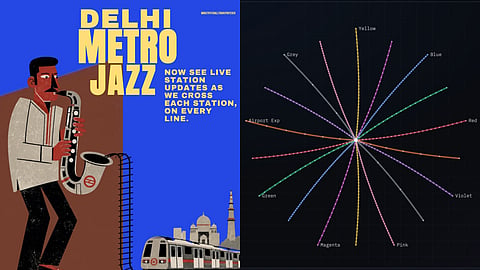
Exploring Delhi Metro Jazz, a web experiment by IIT Delhi researchers Atishay Khanna and Adwitiyaa Pramanik. By mapping DMRC transit schedules, line lengths, and station locations directly to jazz instruments, the project translates raw public transport data into an interactive, real-time musical performance.
Every single morning in Delhi NCR, thousands of commuters walk through the metal detectors, swipe their cards, and step onto the platform. Standard transit maps depict neat, orderly lines stretching across the National Capital Region, carrying passengers from Samaypur Badli all the way down to Millennium City Centre. Schedules, train lengths, and arrival times keep millions of people moving through the city every single day.
For most commuters, the daily train ride is a standard piece of routine — you check your phone, look at the route map, and listen for the automated voice announcing the next stop. Creative technologists have built a digital simulation called Delhi Metro Jazz, turning the entire transit map into a playable musical instrument.
Two transportation researchers from IIT Delhi, Atishay Khanna and Adwitiyaa Pramanik, built a digital simulation called Delhi Metro Jazz.
Working out of the Transportation Research and Injury Prevention Centre, the duo wanted to give people a reason to think about public transit beyond policy documents or municipal spreadsheets. They took publicly available data like line lengths, station counts, and schedule timing, and assigned instruments to each corridor.
The concept behind the project relies on this simulated movement. The Yellow Line connects directly to piano keys. The Blue Line drives an upright bass. The Violet Line controls a tenor saxophone, while the Red Line operates the brush drums.
Whenever a virtual train moves along its track or pulls into a station, it triggers a musical note. These notes are quantised to match a chord progression playing continuously in the background. If three trains arrive at major interchange stations at the exact same moment, the system generates a sudden swell of brass and rhythm. During peak morning hours, when hundreds of trains move simultaneously across the capital, the music builds into a fast, crowded jam session. Late at night, as the trains slow down and return to the yards, the tempo drops into a slow, lazy beat.
The software uses schedule data published by the Delhi Metro Rail Corporation to calculate the timing. Because the real-world schedule varies based on train frequency, the music constantly alters its flow without repeating the exact same pattern. The city itself determines the rhythm, the speed, and the sequence of notes.
Projects like this belong to a growing community of digital builders who look at civic infrastructure as raw material for art. Transit data is usually buried inside PDF tables, travel apps, or government reports. Maps exist to help people get from point A to point B without getting lost.
By running those same numbers through a digital synthesiser, the builders give commuters a totally different way to perceive the transit system. A long delay on the Pink Line is no longer just a minor annoyance on your commute; it becomes a long, sustained trumpet note hanging in the air. A sudden rush of suburban trains turning around at Rajiv Chowk creates a quick scatter of piano keys.
Atishay Khanna and Adwitiyaa Pramanik designed the interface to run directly in a browser, allowing anyone to open the map and listen to the city play itself. Users can toggle individual lines on and off to isolate specific instruments. Muting everything except the Violet Line leaves you with a solo saxophone wandering through central Delhi. Switching on the network brings back the full combo, bouncing across dozens of stations at once.
It turns a rigid public transit schedule into a live, unpredictable musical performance. The sound is surprising, slightly goofy, and completely tied to the movement of the city.
Building the project required a mix of coding skill, data processing, and musical help from friends. The creators mapped station coordinates, calculated average train speeds, and translated physical distance into musical timing. They also chose a musical framework that could handle dozens of random notes hitting at the same time without sounding like complete noise. Jazz turned out to be the natural choice, since the genre thrives on improvisation, off-beat rhythms, and loose structural rules.
Digital art often sits inside galleries, screens, or dedicated museum installations. Delhi Metro Jazz shows what happens when creative code intersects with the physical objects people interact with every day. Khanna and Pramanik took something ordinary — a municipal train schedule — and found a funny, creative layer hidden right beneath the surface.
The next time you stand on the platform waiting for your train to arrive, you can picture the whole network humming along to a brass band. The doors slide open, the chime sounds, and the saxophone takes another solo across the capital.
Visit the magic of this metro musical instrument here.
