
- HOMEGROWN WORLD
- HGCREATORS
- HGEXPLORE
- HGVOICES
- HGSHOP
- CAREERS
- ABOUT US
- CONTACT US
How a sanctuary in the Western Ghats is dismantling the artist-artisan hierarchy, giving 4,000-year-old tribal metalwork room to evolve through collaboration and innovation.
Drive up the winding roads into Panchgani, away from the crowded viewpoints and strawberry stalls, and the air thins out into a cold, damp mist. Set amidst red soil and dense foliage lies Devrai Art Village. The collective draws its name from Devrai — the sacred groves of Maharashtra preserved by local communities for generations out of reverence for nature.
For generations, the global art market placed an arbitrary barrier between urban contemporary artists and tribal artisans. Galleries celebrated modern creators with individual credit and high price tags, while traditional craftspeople were grouped into regional markets, expected to reproduce tourist souvenirs without credit or creative input. Devrai Art Village exists to break this particular barrier.
Founded as a non-profit, the collective brings together indigenous craftspeople, primarily from the Dhokra-crafting communities of Chhattisgarh and Gadchiroli, alongside modern designers. Urban creatives sit on the floor alongside master craftspeople, learning the behaviour of raw materials directly from communities who have worked with them for generations. It functions as a collective space where traditional metalwork instincts merge with spatial, abstract forms.
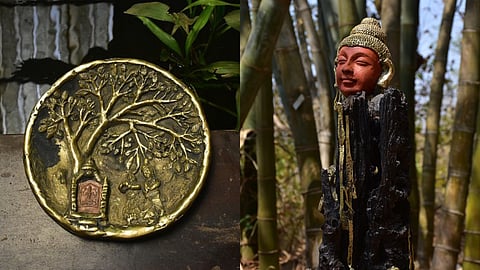
At the core of Devrai’s output is Dhokra, a lost-wax metal casting technique dating back to the Indus Valley Civilisation. Wax threads wrap around clay cores to build intricate patterns, which are encased in local soil molds, sun-dried, and replaced by molten brass poured from charcoal furnaces.
To see how far the technique could be pushed, the collective developed Devrai Rock Dhokra, a patented process unique to the workshop. Artisans cast molten brass directly onto naturally shaped river rocks.
Fusing metal to stone comes with technical challenges, as both elements react differently to heat during the pouring process. Balancing temperature control requires a strong intuition for the materials. The finished pieces feature warm, detailed brass tendrils and geometric patterns anchored to weathered stone bases, yielding functional items like door handles alongside abstract sculptures.
The surrounding environment of Panchgani directly informs the work made in the studio. Artisans set up outdoors under tree canopies, drawing visual references from the local forest. Dragonflies, seed pods, fungi, and spiderwebs are studied right in front of them, turning into designs on metal and stone. The landscape supplies the physical materials, too — found river rocks, fallen branches, and local clay form the baseline for structural molds. This open-air setup relies on manual tools, soil beds, and charcoal furnaces, keeping the process grounded in raw elements. Because lost-wax casting depends so heavily on natural conditions like complete sun-drying, larger metal-and-stone fusions require time and multiple attempts to settle, with individual projects stretching across several weeks.

Many artisans who moved to Devrai come from remote regions in Central India that have been impacted by socio-economic instability. The village offers them stable income, residential space, shared meals, and creative agency over new designs.
Artisans get individual credit for their designs and collaborate with visiting designers as equal partners. Rather than preserving traditional skills through static preservation projects, the collective operates on a model where traditional methods adapt, change, and stay economically viable through active use.
Mass-manufactured home decor relies on uniform plastic molds devoid of human touch. Devrai Art Village offers a practical alternative. It demonstrates that indigenous heritage can adapt to contemporary design demands without sacrificing its original technical language.
